Thomas Wolsey, born to a prosperous butcher and grazier in Ipswich, attended the local monastery school before graduating from Magdalen College, Oxford, at just fifteen. Ordained in 1498, he first served as tutor to the sons of Thomas Grey, Marquess of Dorset, half-brother of Queen Elizabeth of York, then joined the household of Henry Dean, Archbishop of Canterbury. Entering royal service in 1507 as chaplain to Henry VII, Wolsey became Almoner to Henry VIII in 1509 and swiftly rose to power—Archbishop of York (1514), Lord Chancellor, and then Cardinal in 1515.
A prodigious administrator and skilful politician, Wolsey was renowned for his wealth and magnificence. He transformed Hampton Court from a rural manor house into a grand palace. His diplomatic triumph was the Field of Cloth of Gold, but failure to secure the annulment of Henry VIII’s marriage to Katharine of Aragon, and Anne Boleyn’s hostility, led to his downfall in 1529. Wolsey retreated to his archbishopric of York but he never regained influence with Henry VIII and the following year was accused of treason and arrested at Cawood Castle, the archiepiscopal palace in York. He died travelling to London in 1530.
We have published a variety of in-depth articles on places connected to Cardinal Thomas Wolsey.
Christ Church, Oxford
One of Tudor England’s great builders, Wolsey used architecture to underline his wealth and status. He paid for extensive, and expensive, additions to York Place, his London residence, and funded the building work that transformed Hampton Court into a state-of-the art palace. It was therefore perhaps inevitable that Wolsey would want to do as other influential figures had done in the past and found a new college at one of England’s two universities.

Christ Church’s dining hall, the largest pre-Victorian dining hall in either Oxford or Cambridge, was used as a model for Hogwart’s hall in the Harry Potter films. © By permission of the Governing Body, Christ Church, Oxford
In 1525 he obtained the papal bulls and royal letters patent he needed to establish a new college in Oxford, which he named Cardinal’s College. Having acquired the site of an Augustinian priory dedicated to Frideswide, a local saint, Wolsey set his men to work in the construction of an institution that he intended to rival the nearly completed King’s College, Cambridge in scale and magnificence. The Great Hall, Kitchen and three sides of the enormous quadrangle which was to be the centrepiece of Wolsey’s ambitious new foundation were soon completed.
When Wolsey’s failure to arrange an annulment of the King’s marriage to Catherine of Aragon led to his fall from grace in 1530, the incomplete college passed into the hands of the king, who re-founded it as King Henry VIII’s College. This, however, was just a stop-gap affair and in 1545 Henry dissolved his old foundation and re-founded it again as Christ Church with new endowments in the following year.

When Christ Church was re-founded in 1546, Henry VIII decided that the old priory church of Saint Frideswide would serve as both diocese cathedral and college chapel. © By permission of the Governing Body, Christ Church, Oxford
In Issue 7 – Christ Church, Oxford: Founded by a Cardinal, Re-founded by a King, Julian Humphrys looks at the early history of Christ Church, Oxford University’s grandest college. Initially founded by Thomas Wolsey as Cardinal’s College, it was re-founded by Henry VIII and still maintains its royal links today.
Esher Place
The Esher Place that Henry VIII and Thomas Wolsey knew was almost entirely the creation of William Waynflete, who became Bishop of Winchester in 1447, having previously served as headmaster of Winchester College from 1430 and provost of Eton College from 1442. He was a career churchman with strong connections, and a passion for building.
Waynflete built a fine brick grammar school at Wainfleet in Lincolnshire, while he also crafted an exceptionally grand chantry chapel to himself in his cathedral. His residential projects included expanding the Bishop’s Palace at Farnham, while he also took charge of the ongoing work on Eton College Chapel and Tattershall College in Lincolnshire. Towards the end of his long life, Waynflete turned his attentions towards Esher, a residence that he had likely spent a considerable amount of time in as bishop. Work began in around 1475, when he was already in his mid-seventies and continued into the 1480s.

The gatehouse tower is all that remains above ground of Esher Place, most of which was constructed for William Waynflete, Bishop of Winchester in the 1470s – 1480s. It is now a private residence in a modern housing estate. ©Elizabeth Norton
Cardinal Wolsey took up residence at Esher Place in the 1510s (with the agreement of the Bishop of Winchester) while he carried out his building works at nearby Hampton Court. Later, he was famously sent to Esher Place in disgrace in 1529 after failing to secure the annulment of Henry VIII’s marriage to Catherine of Aragon.
On his arrival at Esher Wolsey had found the palace largely unfurnished, ‘without beds, sheets, tablecloths, cups, and dishes’ and was constrained to borrow them from the Bishop of Carlisle and Sir Thomas Arundel. His loyal servant George Cavendish later recalled that on All Hallows’ Day he had come across Thomas Cromwell, weeping as he prayed in the window of the great chamber at Esher and complaining that ‘it is my unhappy adventure, which am like to lose all that I have travailed for all the days of my life for doing my master true and diligent service’.
Esher Place’s proximity to Hampton Court Palace made it a convenient base for king and churchmen alike, to relax, to hunt and to nurse their grief. In Issue 15 – The Lost Esher Place: ‘A place where there is grief’, Dr Elizabeth Norton looks at another of Henry VIII’s lesser-known residences, a fragment of which, most surprisingly, is a private residence today.
Cawood Castle
Little remains of Cawood Castle today, just a stone gatehouse with an adjoining brick domestic range, and the vestiges of some precinct walls, but from the thirteenth century until its slighting after the Civil War, Cawood was one of the most important building complexes in Yorkshire. Although Cawood is called a castle and did indeed see a small amount of military action, the name reflects its high status rather than its primary function. This was to serve as the principal palace of the archbishops of York, providing them and their entourages with both luxurious accommodation and a place to house large meetings and gatherings.

Part of the east range and gatehouse are all that remain of the once magnificent Cawood Castle. The white extension to the gatehouse was built in the eighteenth-century to house a larger staircase. The wall in the foreground would originally have been much higher. ©Julian Humphrys
A modern housing estate now covers much of the area where Cawood’s original courtyards stood. Enclosed by high precinct walls, they stretched all the way down to the banks of the River Ouse. The whole complex would probably not have looked dissimilar to an Oxbridge college, with a castellated gatehouse, private rooms for the archbishop, accommodation for his servants and guests, a chapel, a kitchen, service rooms and at least one hall. The present road runs through the site with the result that when you arrive at the castle you see the inside of its gatehouse before anything else.
In 1985 the Landmark Trust acquired the remains of Cawood and, following an extensive restoration programme, the gatehouse is now available for hire as a holiday let.

The exterior of the Cawood gatehouse, with its original carving above the entrance, would have greeted visitors to the palace. The battlements are replacements and the house to the left is a later addition. ©Julian Humphrys
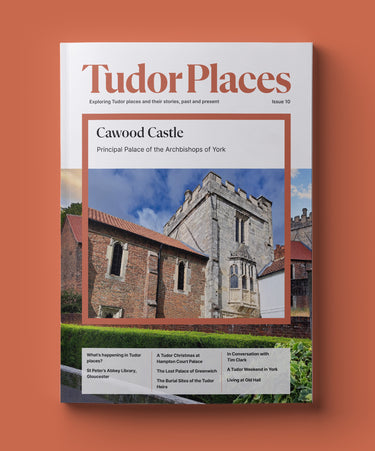
Cawood’s convenient location and comfortable accommodation attracted several royal visitors over the centuries, although Archbishop Thomas Wolsey only finally made use of the episcopal palace following his fall from favour at the Tudor court. In Issue 10 – Cawood Castle: Principal Palace of the Archbishops of York, Julian Humphrys visits the remains of Thomas Wolsey’s last home.
Hampton Court Palace

The astronomical clock was installed above what is now known as Anne Boleyn’s Gateway, facing in towards Clock Court, in 1540 © Historic Royal Palaces
It was Wolsey’s vision (and funds!) which transformed Hampton Court from a moated manor house to a magnificent Renaissance palace. We have a range of in-depth articles written by Historic Royal Palaces’ curatorial staff and guides on different elements of this wonderful palace.
Issue 2 – The Bayne Tower: Henry VIII’s Private World
Issue 4 - The "Wolsey Closet" at Hampton Court Palace
Issue 6 – In Conversation with Rachel Mackay, Head of Hampton Court Palace
Issue 9 – No Time for Sickness: Henry VIII’s Astronomical Clock
Issue 10 – A Tudor Christmas at Hampton Court Palace
Issue 19 – The Lost Riverside Garden Buildings: Henry VIII’s Hampton Court Palace